A CREATIVE JOURNEY BY ROSIE SCRIBBLAH (aka Rose Davies)
I never worked with landscape. Didn’t get it. I’m a townie, I like the streets and the brutal built environment. I like drawing people. I could never get a handle on landscape – it was all too big for me. Until I went to Pakistan almost 20 years ago and spent a week up in the Karakoram Mountains near the Chinese border. I experienced the intervention of humans in the landscape, the work of ancient artists; and this set me on a journey to discover the ancient heritage of my own country, Wales, which I had taken for granted. This was my way in to the landscape, but even so, it took a few years, churning around wherever it is that artistic inspirations comes from.
Along the way I worked with Rhondda-born pre-historian and author Dewi Bowen, and Swansea-born filmmaker Melvyn Williams. From our collaboration Dewi published a book, Melvyn made a short film and I produced an awful lot of images. This exhibition is a record of that journey. I hope you enjoy it.
Dewi’s excellent book, Hunting The Wild Megalith, can be bought from Swansea Print Workshop’s Online Shop.
PART 1: THE ANCIENT KARAKORAM STONES
I went on a fantastic trip to Pakistan 10 years ago and spent almost a week up in the Karakoram Mountains, in the North East near the Chinese border. The scenery was truly breath-taking. It was Springtime and the palest pink apricot blossom filled the air with a delicate scent, the gnarled old trees stood out against the vivid blue-grey of the snow-capped mountains above the Indus Valley. Our hotel was at 4,500 thousand feet, half as high again as Eryri (Snowdon) and there were few tourists from abroad apart from coachloads of Japanese, come to visit the flowers.
Brightly coloured skeins of dyed wool looped across gardens. Local women spin, dye and weave goat and sheep wool, making exquisite carpets and embroideries. The beautiful colours on the yarns come from local plants. It’s a simple way of life and traditional skills are valued. Women are economically active and get a good price for their crafts. Mining for gemstones is also a main industry here – emerald, diamond, sapphire, ruby and many semi-precious gems.
One day we set off in some jeeps to drive further up the Karakoram Highway. It’s a precarious road, we drove through tunnels in glaciers, landslides and waterfalls. Some of the highest mountains in the world are here including Chogori (K2), Rakaposhi and Nanga Parbat. Our driver slewed to a halt and shouted to everyone to get out, which was a bit alarming as we were many miles into the wilderness. But then we saw the sign for a sacred site. Huge boulders near the side of the road were covered with ancient petroglyphs, small engravings in the rock, mainly animals, ibexes and horses, with the occasional human figure, painstakingly picked away by artists who carved the designs using stone tools on stone; meticulous work, so fine, so dedicated.
I got out my sketchbook and drew: hunting scenes; animals grazing; a few human figures. Most of the people were shown hunting but there was a pair, a man and a woman, carved on their own. What did it mean to me, seeing these? I was immensely moved. Artists centuries ago had created these exquisite artworks. Hardly anyone has seen them. They’ve survived weather erosion and the rise and fall of civilisations. When I came back I took some of my drawings and carved them into lino and printed them up at Swansea Print Workshop.
PART 2: DRAWING THE INCREDIBLE JOURNEY
We had travelled up to the Hunza Valley by road, which helped us acclimatise gently to the altitude, from Islamabad to Besham, our first overnight stay. I worked into my sketchbooks with Faber Castell Pitt drawing pens and watercolours. One day we travelled in jeeps to Eagle’s Nest, almost 9,000 feet up. The textures and colours of the landscape were wonderful. Many thousands of potato trenches stippled the mountains, punctuated by poplars against the soft pink of millions of apricot trees.
I sat on the verandah of our hotel, at around 4,500 thousand feet, and sketched the ancient Baltit Fort, overshadowed by the looming mountains. On the road, many miles from anywhere, between Besham and our destination Karimabad, we stopped at a very old roadside café with a roof terrace up some very rickety wooden stairs. We stayed a while in the sunshine, eating, drinking tea and soaking up the extraordinary views. The transport café was not considered salubrious enough for the very few women travellers so the roof terrace was provided as a private space . We definitely got the better deal!
PART 3: FOLLOWING THE MABINOGION’S BOAR HUNT
When I returned I became a bit obsessed with ancient art, read up loads of stuff about cave paintings, went to look at Paleolithic artefacts at The British Museum and even spent some time studying Native American petroglyphs on boulders in the Wild West. But that’s another story. I started to look at my own heritage locally with Arthur’s stone on Cefn Bryn, Gower – the destination of many primary school trips in a double decker bus with a brown paper bag filled with jam sandwiches, hard boiled eggs and crisps .
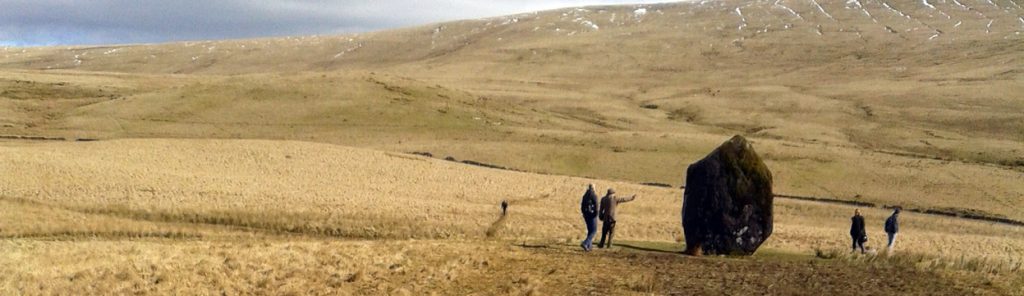
And then at the end of 2015, I was chatting to Filmmaker Melvyn Williams and Prehistorian Dewi Bowen about working together. Dewi was doing field research for his latest book, linking the Mabinogion tale of Y Twrch Trwyth with ancient monuments across South Wales and Melvyn had long wanted to make a film of him. So we went out every couple of weeks for about three years to find these stones and record our journey. I only went along in the beginning for the ride, but that soon changed.
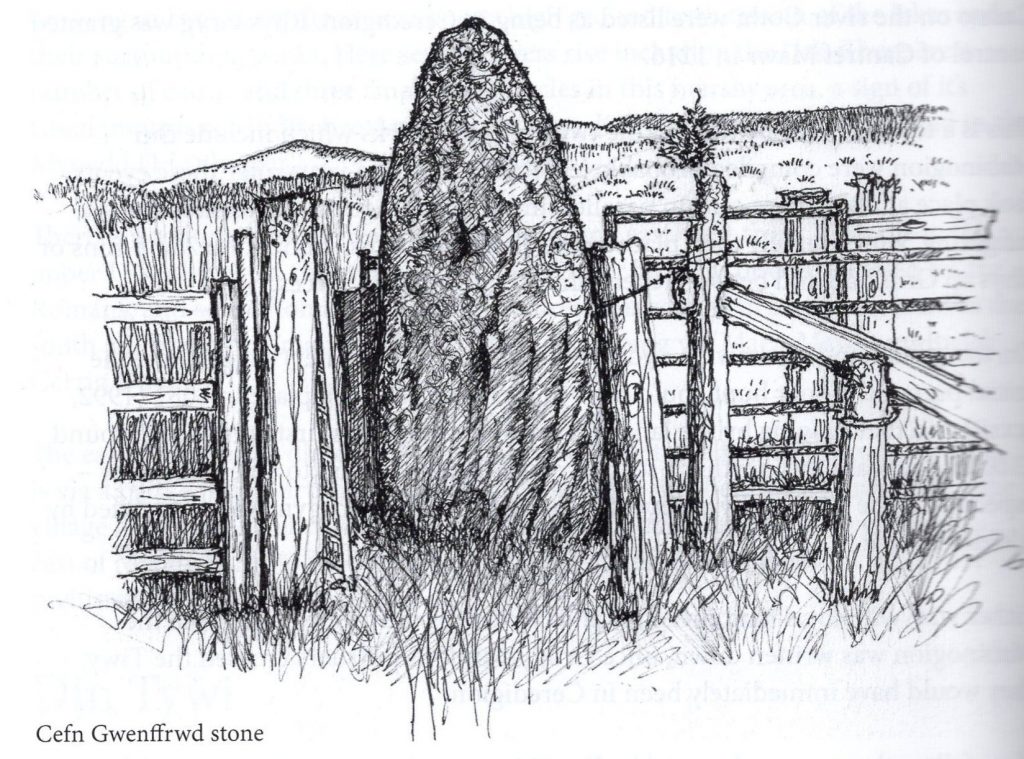
At first I just went along with some sheets of white paper and charcoal and my drawing board. Although I enjoyed doing the drawings, the white paper just didn’t feel right, so I tried marbled paper and I also used white conte crayon onto black, but I still wasn’t happy. Then I found some experimental sheets of paper I’d prepared with gesso and some walnut ink I’d made and that gave me my style and focus. I worked over the walnut base with charcoal, carbon and conté crayons in white and sanguine. The standing stones were relatively easy to draw, but I had to take a different approach with some sites where cairns had disappeared into just contours and hummocks.
Some cultures have many words for snow. Here in Wales we should have many words for MUD! I didn’t know it was possible to wade through so many different types; the stinking slurry at the entrance to fields of cows; the red-streaked mud littered with sheep placentas in Spring with annoyed red kites wheeling around above, wanting their dinner; the freezing and very slippery grey mud on the banks of the Usk that I fell backwards into! After a first encounter with wild ponies, who wanted to liberate our lunchboxes, we started carrying bags of cut-up apples and carrots to appease them.
As we journeyed across South Wales, following the Mabinogion trail, my work began to get quite abstract – not like my usual representative art – but the stones somehow encouraged me to experiment, as did the weather! The paper preparation in the studio takes a long time and is painstaking, but the drawings in the field have to be done quickly, the weather can be brutal. As time went on, I started to use Daler Rowney soft pastels on top of the prepared walnut paper.
There are some stones on farmland, we always asked permission from farmers and followed the countryside code and in the majority of cases we were well received. Working en plein air is really good exercise, artistically and physically.
PART 4: CLOSER TO HOME
After travelling across South Wales, and as Winter drew in, we focused on the stones closer to home and I had a few surprises. I’ve lived in Swansea all my life and didn’t know about the magnificent stone on the old Bonymaen village green outside the pub. It’s about 5,000 years old. The Cockett Valley stone had remained hidden in woodland until the late 20th century when the adjacent school wanted to extend its playing fields and found it. You can arrange a visit to view with the headteacher.
The Cwrt Sart monument in Neath had been in the school playground for many years. We visited shortly before the old school was knocked down and replaced with housing, but fortunately the stone has been preserved. It really lent itself to abstraction and I had fun with mark-making, to the puzzlement of the schoolkids. The legend of Ty’n Y Selar in Margam says that before cockcrow on Christmas Day it uproots itself and goes to the river for a drink. When Saint Samson threw the stone to its present position, the area would have been beautiful, but now it’s hemmed in by a motorway, railway line and industrial estate. It is still magnificent though.
PART 5: FURTHER AFIELD AGAIN
Springtime encouraged us to get out into the wilds again, to Carmarthenshire and Pembrokeshire. We visited stones in built-up areas; the front garden at Carmarthen Museum; outside the Bowls Club in Bridgend. We went up mountains; to the source of the River Usk where I fell backwards into the soft grey mud; to Mynydd Drummau, at the intersection of a number of ancient animal trails. We encountered the best and worst of Welsh weather, often fine and sunny when we left the car, but hit with horizontal snow when we reached the monument. It sometimes felt that the mountains were testing us.
We visited the stone of Sant Elfys. Near the Preseli Mountains. Elfys (Elvis)? Preseli (Presley)? Coincidence? And we found a beautiful reddish stone, Carreg Coch, in a hedge surrounded by barbed wire, which has probably protected it for centuries. At Penlan Uchaf the stone looked alive and may have been chosen because it resembled a face. Often stones are covered with life, many tiny plants create beautiful colours.
I had a strange experience drawing the Bridgend stone, outside the Bowls Club, it just didn’t “feel” right. I was told it was originally a few meters away. It was weird seeing a stone out of place. I started to wonder if these stones had been placed with an artist’s eye? When we visited Cylch Gors Fawr, in Mynachlog Ddu I became convinced that the ancients considered aesthetics when they placed the stones. Are these very early manifestations of environmental art?
Some stones dominated their landscape; The Bryn Maen Farm stone, Llannon; the Mynydd Drummau stone, Parc Y Meirw (Field Of The Dead) Stone Row, Pembrokeshire. Sometimes a monument has all but disappeared, like Carreg Jack on Llansteffan beach. And some are still evolving, like Tair Cairn which has a little modern rock sculpture that someone had put on top. These still grow; people pick up rocks from around and add to them.
Finally we reached Pentre Ifan, full circle from where I started my journey of discovery some years ago in Pakistan. Through my three year journey along the route of Y Twrch Trwyth, I developed a body of work, mostly done en plein air, that pushed the boundaries of my artistic practice and helped me to discover my historic and cultural heritage.
Melvyn’s entertaining film of our journey across South Wales, following the trail of the ancient boar hunt is here below.
Hunting the Wild Megalith | Dewi Bowen & Olwen Pritchard
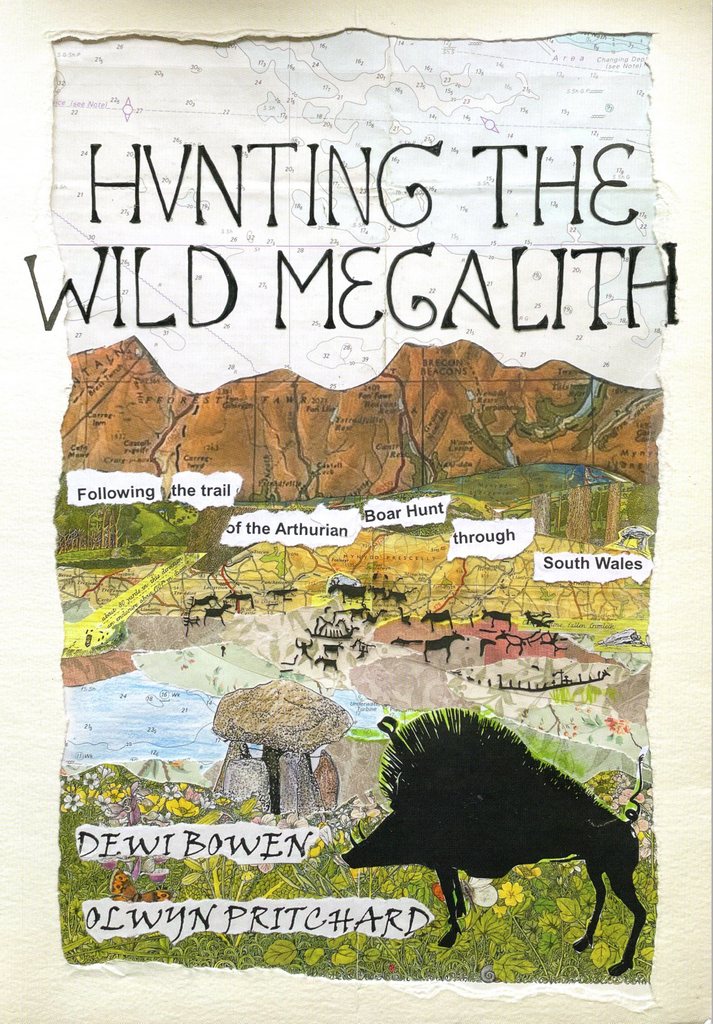
In the Spring of 1992 Dewi Bowen began to follow the trail of the Arthurian Boar Hunt from the cliffs of St Davids to the shore of the Severn. 28 years later with the help of a small team and the assistance of the archaeologist Olwyn Pritchard the quest was completed. Learning along the route, they combine basic astronomy, place-name evidence and natural wayfaring to write an eclectic and gossipy guide to the ceremonial sites of South Wales. A curious mix of scholarly research and half remembered Silurian songlines.